
From Spreadsheet Chaos to a Controllable ERP Workflow
How a mid-size manufacturing company replaced 47 interconnected spreadsheets with a modular ERP platform, reducing reconciliation errors by 90%.
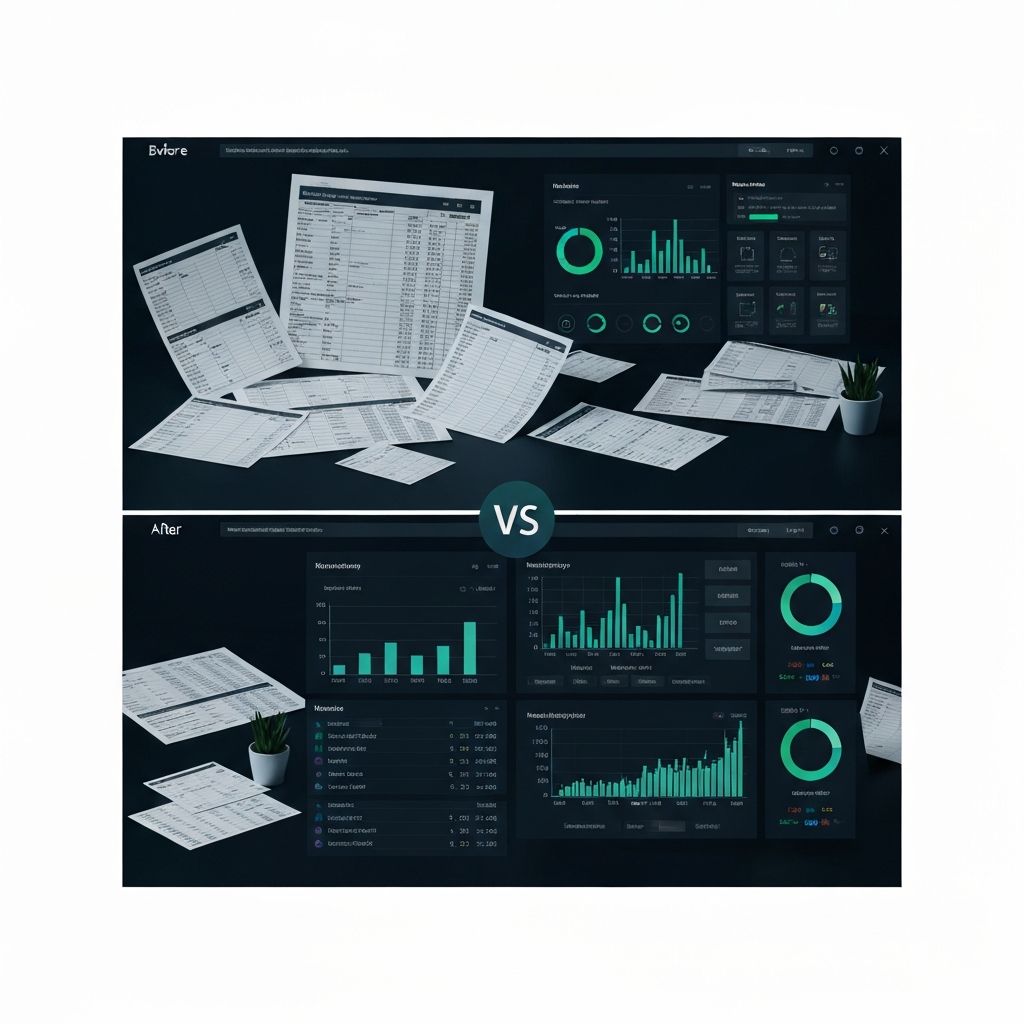
The Challenge
A manufacturing company with 200+ employees had been running core operations through a web of 47 interconnected Excel spreadsheets. Purchase orders, inventory counts, production schedules, and financial reconciliations all lived in files shared across network drives, with manual copy-paste operations connecting one process to the next.
The consequences were predictable: version conflicts, data entry errors, reconciliation delays, and an inability to generate reliable real-time reports. Month-end closing took two full weeks.
Our Approach
We began with a two-week discovery phase, mapping every spreadsheet, its data flows, and the business rules embedded in formulas. This produced a comprehensive process map that revealed redundancies and bottlenecks invisible to the teams using them daily.
The architecture centered on a modular .NET backend with domain-driven design, decomposing the monolithic spreadsheet logic into discrete bounded contexts: Procurement, Inventory, Production Planning, and Financial Reporting. Each module communicated through well-defined APIs and event-driven messaging via Apache Kafka.
The frontend was built with Angular, providing role-based dashboards for each department. Real-time data synchronization replaced the manual refresh cycles, and automated validation rules caught errors at the point of entry rather than during reconciliation.
Results
- 90% reduction in reconciliation errors within the first quarter
- Month-end closing reduced from 14 days to 3 days
- Real-time visibility into inventory levels and production status
- Audit trail for every data change, replacing the guesswork of spreadsheet version histories
The platform now supports 150 concurrent users across four facilities, with automated backup and disaster recovery built into the cloud infrastructure.
Facing a similar challenge?
Let us discuss how our experience in this domain can help your organization achieve similar results.
Start a Conversation